
How to Evaluate Your Nanny’s Driving Skills
July 18, 2012 Hiring a nanny can be a stressful, time-consuming process. Once you’ve narrowed down the field of candidates and have conducted a round of interviews, there’s still one crucial hurdle along the path of hiring that you must clear: conducting a background check.
In addition to national and county court records checks, a thorough background check will include a review of the candidate’s motor vehicle driving record. However, these background checks and reviews only return results if a prospective nanny has been caught driving badly. If your nanny won’t be driving your children to or from school, play dates, and extracurricular activities, you may not be overly concerned with how honed her driving skills are. That being said, if there’s even the slightest possibility that your children will ever have to climb into a vehicle with your nanny at the wheel, whether it’s due to an emergency or an unforeseen development, it’s absolutely essential that you evaluate her ability to safely handle it and transport the children.
Determine Their Familiarity with the Area
Even a skilled driver can be dangerous when they’re navigating unfamiliar territory, so determining her driving safety begins with figuring out her knowledge of the area. A nanny who’s lived in your city for years and is familiar with your neighborhood isn’t necessarily a better driver than the woman who just moved into the state, but she is less likely to become dangerously disoriented or frustrated due to being lost, which could potentially lead to an accident. If she arrives at the interview and seems flustered or anxious, it might be a red flag that she’s not yet familiar enough with the area to drive safely with your children in tow.
Take a Good Look
While any major accident will require repairs by a skilled auto-body repair-person, many drivers do not submit insurance claims for minor dents. If your nanny’s car is riddled with dents, scratches, and other signs of collision, especially if it’s a relatively new car, it might be worth questioning her abilities.
Another strong indicator of safety behind the wheel is age and experience level. A thirty-year-old driver who’s had a license for less than five years is likely to be a more responsible and cautious driver than a twenty-something, but she does not have as much practical driving experience. Both factors are important ones, and weighing them carefully is an essential part of making an educated estimate about a prospective nanny’s driving skills.
Observing her as she approaches and drives away from the interview site can provide more valuable clues about her ability, especially if she’s naturally reckless or makes a habit of driving with distractions.
Hire a Service
If a clean background check isn’t enough to ease your mind, and subtle observation isn’t yielding results, there are companies that provide driver monitoring. Methods include dispatching a monitor to follow your potential nanny, observing her driving habits and documenting them for review, installing GPS and vehicle diagnostic units that track driving habits of an individual, and supplying an “Is My Driving Safe?” decal that encourages other drivers to report poor or dangerous driving. You may also be able to obtain information through a private investigator, especially if you’re using one to conduct your pre-employment background checks. Before employing any of these methods, however, it’s advised that you inform your nanny candidates of your intention to do so and obtain their permission to avoid disputes and potential legal action in the future.
The Direct Route is Usually the Most Effective
Rather than resorting to cloak-and-dagger spy routines, you might find that you learn everything you need to know by approaching candidates with honesty and sincerity. Professional nannies will understand your hesitation to allow an untested driver to transport your children, and will answer any questions that you may have. She may also consent to a “driving test,” letting you ride in the vehicle to evaluate her performance and skill level on the spot, in a one-on-one environment. Inquiring about past accidents, moving violations and other pertinent information is more likely to turn up honest answers if your approach is frank and up-front; learning that you’re trying to uncover such information through subterfuge or a third-party service could make even an experienced, capable driver clam up out of frustration and indignation at the invasion of her privacy.
Whatever method you choose, the most important thing you can do is to be honest and forthcoming, both about any doubts or misgivings that you may have and about the avenues you intend to pursue in order to uncover the information you seek.
Posted in Background Check | Comments Off on How to Evaluate Your Nanny’s Driving Skills10 Nanny Interview Questions About Their Work History
July 9, 2012 When interviewing potential nannies, one of the things you will want to consider is the prior work history of each candidate. Knowing a nanny’s previous employment history will help you decide if the candidate has your desired level of childcare experience, and can also provide insight into any patterns that you need to be aware of, such as the typical amount of time she stays with a family.
During the nanny interview, consider asking these pertinent questions about a candidates’ work history.
- Why did you decide to be a nanny? – Knowing the individual’s motivation to enter the field of childcare may give you an idea of their level of commitment to the position and nanny profession. Certain things motivate people to go into a particular career. Some people follow a family tradition, others may just happen to fall into it, while still others feel it’s a calling or something they were born to do.
- How long have you been in the childcare field? – Some interviewees will have a childcare background in other related areas, such as a day care provider or nursery school teacher. This additional experience with children could prove to be a plus since the candidate may have experience working with several different types of children and found different ways to handle various situations.
- How long have you been a nanny? – Being a nanny requires skills that may not be necessary in other childcare positions, but are critical within a private family setting. When the family and the nanny are both new to the relationship, there is a lot of learning together that takes place. When either the nanny or the family have a lot of experience and the other does not, there is teaching and learning that’s going to occur. Families may not know what’s expected of them if they are new to the situation and the same is true if the nanny is new to the profession. In this case, the one with the most experience will need to help the other adjust to the role. In the case where both nannies and families have experience, it’s really just a matter of making sure personalities and styles mesh together well.
- What did you do before you became a nanny? – Previous work history may enhance what the candidate has to offer. If the person has some history that could have a positive impact on your children, you may want to explore that area a little more as it relates to your children.
- What are some of the challenges you’ve had in your positions as a nanny? – Everyone has challenges of some sort in their work life. Knowing what challenges your candidates have faced and how they handled them will help you gain some insight into how similar situations may be handled in your home.
- What do you like most/least about being a nanny? – There are pros and cons to all jobs. If your applicants are willing to share with you what their views are on this topic you will be better prepared to make a wise decision in hiring the most qualified and dedicated person for the position.
- What do you feel has been your biggest accomplishment in this career? – It can be difficult to toot one’s own horn, especially on command; yet, it is good to know that the person you are choosing does have some accomplishments under her belt. It can be as simple as getting a fussy child to eat something new or as grand as winning the International Nanny Association Nanny of the Year award, but whatever the feat, it’s good for you to know that your candidates can call up something that they’ve achieved beyond the usual.
- Can you share a difficult situation that you now wish you would have handled differently? – Most people experience difficult situations in life and oftentimes the real challenge comes not in the difficulty itself, but rather in how it is handled. Some people do well in the moment and others make blunders, but they are able to see later how they could have done better and thus learn from their mistakes. Asking candidates to share such an experience with you will allow you to see how they manage tough situations.
- What do you feel is the most important aspect of this position? – There will be differing views concerning the important aspects of childcare. In reality, there is probably really no “one” specific aspect that is paramount. Several are crucial and checking to see if you and your applicants are on the same page, or at least close to being on the same page, is vital to having a good relationship with your nanny.
- What would your previous family say your strongest assets are? – Interviewees should be aware of their assets, and phrasing the question in this way will also give you an idea about the relationship with the former family, if there is one.
A candidate’s work history can provide valuable information and insight into how she works with families, handles challenges, views herself and feels about how others view her. You can learn something about a person’s work ethic and philosophy by digging into past employment relationships. Asking pertinent questions that will give you an idea about how the person will work and relate to you and your children is exceedingly important.
Posted in Background Check | Comments Off on 10 Nanny Interview Questions About Their Work History5 Dangers of Leaving a Child in a Car Unattended
July 7, 2012 When you’re juggling two arms full of groceries and a diaper bag, it can be very tempting to leave a child in the car unattended, just for long enough to drop your load and take a breather. There’s a chance that nothing tragic would happen; there are also a million reasons why you never, ever should. The dangers that lurk in and around your car can be quite surprising, even to the most cautious parent. Here are five of the reasons why you should never leave your child in the car unattended.
- Weather Conditions – Every summer, the media is spurred to run public service announcements to remind parents of the danger that they put their children in when they leave them unattended in a hot car by a handful of tragic deaths early in the season. Infants and small children are more sensitive to heat than adults, who may underestimate the temperature and the very real risk of heat stroke or even death that could result from even a short stint in a hot car. According to the North Carolina Department of Health and Human Services, when the outdoor temperature is 93º, the interior of a car can rise to 125º after as little as twenty minutes.
- Children Can Accidentally Set Cars in Motion – Toddlers can be capable of escaping their car seats without a parent’s knowledge, leaving them free to move around the interior of the car in their absence. Bumping into or manipulating the parking break or gearshift can cause the car to roll down even a very slight incline; the potential for tragedy in such a situation is incredibly high. A moving vehicle can very quickly pick up speed in these incidences, creating a potentially hazardous situation for pedestrians as well as the child trapped inside of the vehicle.
- Kidnapping – The vast majority of children abducted in the United States are taken by a family member. In fact, the Department of Justice states that an estimated 82% of juvenile kidnapping cases involve a relative, rather than a stranger. While a child is clearly more likely to be abducted by a family member than a stranger, 18% is nothing to sneeze at. Leaving your child unattended in a vehicle, even on a temperate day with the windows down with no risk of the child accidentally setting the car in motion, is still leaving them open for attack. Though no parent wants to teach their child that there is danger lurking behind every bush and a kidnapper in every shadow, leaving a child unattended and unsupervised does have the potential to lead to every parent’s worst nightmare. Stranger abductions do happen, even in small towns across America.
- Choking and Strangulation Hazards – Alone in a car with no one to hear them, children can choke on food, toys and even found items if they manage to wriggle free of their car seat. In addition to the risk of choking, toddlers and small children may also tangle themselves in a seat belt, causing strangulation. There are so many surfaces and features inside of a car that could potentially harm a child, especially a small one who doesn’t quite grasp the concept of “risk.”
- Trunk Entrapment – Older children that are left in a car unattended have a tendency to get bored, especially if they have no mobile device or MP3 player to distract them. As every parent knows, boredom generally leads to trouble. The ability to access the trunk of some cars through the backseat was intended as a safety feature, but it may allow an inventive child to access the trunk and crawl inside. After closing themselves up, kids may not know how to get back out; in addition to the danger of heatstroke, kids could also suffocate after being trapped in a mostly-airtight trunk.
Depending on your state, you may even face criminal charges for leaving your child alone in the car; California, for example, has a law specifically prohibiting any adult from leaving their child unattended in a vehicle. Prosecutors across the country are filing child abuse and other related charges against the parents of children discovered in hot vehicles as well. There are so many things that can go wrong when a child is left unattended, even for the briefest moment; it’s simply not a wise choice to take such a risk with the life and well-being of a child at stake.
Posted in Uncategorized | Comments Off on 5 Dangers of Leaving a Child in a Car Unattended10 Nanny Interview Questions About Their Personality
July 3, 2012 When you hire a nanny, in many cases you are hiring someone who will eventually become a person who is regarded as an extended family member. Because of this, it is essential to make sure that this person fits into the general family culture. It is also imperative that he or she has personality traits that you are willing for your children to emulate. You have a short period of time to initially get to know the candidates you are interviewing, therefore you need to ask questions that will quickly enlighten you regarding their personalities; here are a few questions for you to consider:
- How would you describe your personality? – We don’t often see ourselves as others see us, but it is still good to ask the question and get an idea of how the applicants view themselves. Answers to other questions in the interview will either support their view or show you a different side.
- Share a humorous story from your last position. – Does the person have a sense of humor? If so, what kind? The story that’s chosen and the comments about it can be telling. If you are a fairly good judge of character, you should be able to tell if the person is telling a story from a place of genuine caring, sarcasm, self-deprecation, or if it’s in poor taste, etc. What the candidate finds humorous can tell you a lot about them.
- What is the most upsetting thing that has happened to you as a nanny and how did you handle it? – The answer may reveal whether the person has a positive, proactive type of disposition or another, less desirable type. There will be upsetting things that come up and various personality types will deal with the situations differently.
- How do you work within a team? – Working within a family is, in essence, working within a team. A nanny should have excellent leadership skills and at the same time be able to be a good team player. People with more independent personalities who are not able to work well with others can be challenging when it comes to differing opinions. You need to be able to present a united front with your nanny when it comes to managing life with your children.
- If we/I did or said something that you honestly could not agree with, what would you do? – This may sound like a trick question, but you need to know that your nanny is willing to ask questions and be bold enough to respectfully disagree with you at times. It is okay to agree to disagree. A person who is unwilling to stand up for what they believe is right is not necessarily the person you want as a role model for your children.
- Do you have any hobbies? – Hobbies can say a lot about a person beyond their creativity. Introverts may do a lot of reading while extroverts are more into team sports. Is the person adventurous? An avid volunteer may be very compassionate while someone who has a unique hobby may be eccentric in a good way.
- Do you have any pets? – Not to stereotype, but there does seem to be a certain personality type attached to the type of pet a person has, especially when it comes to cats and dogs. Dog people have a tendency to be more team players and willing to work within groups. Cat people are often more independent and like to take positions of authority. But, those things aside, if a person can take care of a pet it’s a good sign that they are open to caring for others.
- Do you prefer to make the rules or follow them? – A person who has confidence to step into a role of authority is a rule maker. Chances are, a nanny of this persuasion will work alongside you with raising the kids and will be able to deal with most situations without your counsel. A follower can be in a role of authority as well, the difference is that a nanny of this type will probably look to you more for leadership and the handling of tough situations.
- What would you like to be doing five years from now? – A question such as this can give you a little insight into where the person’s aspirations lie. You may have to draw out some information and ask other questions along with it, like if they have any plans for further schooling or travel, etc.
- What about your personality makes you well suited for this position? – People choose jobs for a variety of reasons. Asking this particular question allows the candidate to tell you how their personality type is a good match for the position. Not every personality is suited for childcare.
Learning about the personality of potential nannies is vital because this person is going to become a part of your family. Their personality will have a direct impact on your children, and the time spent with your children will influence your children’s views and behaviors. It is critical that the person hired to watch over your child has the qualities that you would like your child to follow.
Posted in Background Check | Comments Off on 10 Nanny Interview Questions About Their PersonalityWhen You Get a Bad Reference From a Past Nanny Employer
June 21, 2012 If you’ve been in the nanny line of work for any real length of time, it’s bound to happen eventually. Sooner or later you’re going to get a bad reference, or at least a reference far less stellar than you may have thought it was going to be.
Former employers give nannies bad references for a variety of reasons and sadly, some of the reasons have little to do with the quality of childcare provided by the nanny. A nanny may get a bad reference because the employer is disgruntled that she left her position or refused to renew a contract. A nanny may get a bad reference because the nanny and family weren’t a good match. Nannies have even been known to get a bad reference because the parents didn’t like the way that their nanny folded the laundry, although that was never once mentioned during the duration of their employment.
While sometimes a nanny gets a bad reference because of the quality of care she provides, sometimes she gets a bad reference for other non-related reasons.
When you are faced with a bad reference and you know it has nothing to do with the quality of childcare you provided, there are a few ways you can handle it.
First, you can be honest and upfront with your new prospective employers. While you should always be professional and speak in a respectful manner about your past employers, there’s nothing wrong with stating that the relationship ended due to a clash in personalities, a change in expected duties, or that the match simply wasn’t a good one.
Second, you can present references from others who observed your work with the family. If you expect that a reference may not be as glowing as you’d like, ask for references from preschool teachers, neighbors, or others who witnessed your daily interactions with the children in your care. Having even a simple letter from a credible reference that states that you were observed caring for the children and that you are recommended for working with children can go a long way to counteract a negative but explainable reference.
Third, you can gather proof of a job well done. Many nannies receive thank you cards from their employers or holiday cards that include a nice bonus. Gather into a file the things you’ve received from the families with whom you have worked. If you received annual reviews and have copies of those reviews, include them in the documentation you present a family who is seriously interested in hiring you. Providing proof that your work was appreciated and respected by a former family can help to discredit an unjust reference.
Fourth, you can go back to the family. If you think a reference will be a negative one, try to make amends with the family before providing their contact information. Asking a former employer to focus on the quality of the childcare you provided, rather than any personal issues that they may have with you, could encourage them to evaluate their motive for giving you a negative reference. If you feel an apology to an employer would smooth over the situation, issue one. Mending broken fences is essential to getting good references in the personal service business.
Fifth, you can address the bad reference with a family. Perhaps you’ve been a nanny for several years now, but during your first position, you had a lapse in judgment and made a mistake, like disclosing to the child’s teacher the parents were getting divorced without their permission. Coming clean about a past mistake to a potential employer and sharing what you learned from the situation, including how it affected your work moving forward, can demonstrate a sense of maturity to a potential employer.
Dealing with a bad reference is never comfortable, but if you want to secure employment, sometimes addressing a bad reference is necessary. Regardless of how you choose to address a bad reference, it’s always important to address it with honesty, transparency, and integrity, character traits parents’ value in prospective nannies.
Posted in Background Check | Comments Off on When You Get a Bad Reference From a Past Nanny EmployerWhat Parents Should Consider When a Nanny Reference Call Goes Bad
June 17, 2012 You’ve finally found a nanny that seems to be your family’s perfect match. She has extensive nanny experience, a degree in early childhood education and a passion for baking gourmet healthy treats, something your family could surely benefit from. She’s in your salary range, she lives a few miles away and she’s available to start when you need her.
Your first interview went well and when she met the children, they seemed to instantly click. You are ready to hire your children’s nanny. Everything from here on out is a mere pre-employment formality.
Or so you thought.
While your nanny’s first reference for her most previous employer was glowing, as expected, her second reference, not so much. After three years of service with this family, you were surprised to learn that they found the nanny to be irresponsible and would not recommend her to care for children.
Now what?
When presented with a bad reference, it’s important to keep a few things in mind:
1. What is the motivation for the reference? Sometimes when a nanny leaves a family, the parents feel rejected, hurt and angry. This is especially true if the relationship did not end on the best of terms. Did the reference sound like she was bitter about the nanny leaving, or did she seem concerned for the safety of your children if you should hire the nanny? Understanding the motivation of the reference can help you determine the quality of the reference provided.
2. Did anything specific contribute to the reference? Was the reference able to cite any specific situations that resulted in her dissatisfaction with the nanny? Does the negative reference relate to a clash of personalities or did the nanny put the children in harm’s way? Is the reference vague or are specific examples that demonstrate her opinion of the nanny revealed? Did the reference’s expectations of the nanny sound reasonable? Understanding what contributed to the reference can help you to objectively evaluate it.
3. Are you being open minded? Have you embarked on your reference checking assignment with objectivity? Are you willing to admit that your candidate isn’t as good of a match as you originally thought? Did you listen intently to what the reference said, or did you tune her out when what she said was something you didn’t want to hear? Are you able to set your emotions aside and truly evaluate the reference? If you feel that you can’t be objective, asking a spouse to recheck the reference may make sense.
4. Does the length of employment speak to anything? Is it of interest to you that the nanny had worked with a family for several years, with seemingly no complaints until after she quit or was let go? Does your nanny candidate have any other documentation, like letters, cards or written reviews from the same employer that indicate they were pleased with her performance? Does she have good reference letters from others who have seen her in the position, like teachers or neighbors? If the nanny has been with the family for several years, you’ll need to consider why action wasn’t taken sooner if the employer was unsatisfied.
5. Could there be two sides to the story? Does what the reference is telling you make sense? Does another story seem plausible? Does it seem like there has to be more to the story? Does the reference seem credible? Typically, there are two sides to every story. You’ll need to consider if the reference one alone adds up.
6. Did the nanny warn you about the reference? Did the nanny hint that the job ended on bad terms and the employer was not happy? Did the nanny mention that the job wasn’t a good fit? Was the nanny hesitant about giving that reference? Would the nanny be surprised to learn she got a bad reference? If the nanny let you know that a reference may not come back glowing, you may wish to go back to the nanny and find out more about why she thought the reference would be bad.
Ultimately what you do with a bad reference is up to you. If your candidate has several other glowing references, her education has been verified and her background check has come up clean, then you’ll need to consider how much weight, if any, that a bad reference is really worth.
Posted in Background Check | Comments Off on What Parents Should Consider When a Nanny Reference Call Goes Bad10 Movies Where Characters Failed Background Checks
May 28, 2012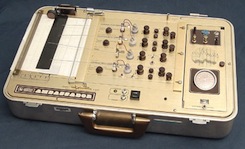 Though modern Hollywood likes to make a background check out to be as simple as a few keystrokes when it’s anything but, there’s no denying that there are several hit films whose characters are the subjects of a failed background check. While the methods for finding the information might be less than realistic in some cases, here are ten films in which a character finds that information they’d rather leave buried comes to the surface with a bit of digging.
- The Girl With the Dragon Tattoo – Whether you opt for the subtitled Swedish original or the slick Mara Rooney-helmed Hollywood version, these films based on the blockbuster Steig Larsson novels center around character Lisbeth Salander’s background check on magazine owner Mikael Blomkvist.
- The Devil’s Own – This 1997 thriller starring Brad Pitt and Harrison Ford features secret identities, IRA ties and an FBI discovery of Rory Devaney’s true identity: IRA gunman and “ruthless terrorist.”
- The Music Man – The charming drifter played by Robert Preston in 1962’s “The Music Man” finds himself on the receiving end of an Iowa town’s ire when his past comes back to haunt him after an anvil salesman exposes his plans.
- Enemy of the State – The 1998 Will Smith movie, “Enemy of the State,” centers around surveillance and data collection of citizens by the government. False information, blackmail and corrupt politicians all come together in this thriller.
- Changing Lanes – Samuel L. Jackson’s character Doyle Gipson finds himself embroiled in a feud with a New York City attorney, played by Ben Affleck, in this 2002 film.
- The Bourne Supremacy – The last installment of the Bourne trilogy, based on Robert Ludlum’s bestselling novels, finally turns up the answers to Jason Bourne’s past and ends his search for his true identity.
- The Last Boy Scout – Joe Hallenbeck, a private investigator played by superstar Bruce Willis in this 1991 film, uncovers a far-reaching plot of bribery and blackmail with the aid of a former football star.
- Secret Window – In this thriller based on a Stephen King novella, an author being terrorized by a reader claiming that his manuscript was stolen hires a private investigator to find out more about the mysterious man. The background check and investigation of the figure turns up shocking results, indeed.
- 8MM – When private investigator Tom Welles, played by Nicolas Cage, is hired to track down a young girl seemingly murdered in a film left behind in a tycoon’s safe upon his death, the long and treacherous journey leads to shocking revelations.
- A View to a Kill – Looking into a horse-racing scam leads the legendary 007 to an industrial tycoon with a master plan for domination in this 1985 installment of the classic spy film franchise.
The value of a thorough background investigation is depicted clearly in these ten films, proving that there’s no such thing as being too cautious.
Posted in Background Check | Comments Off on 10 Movies Where Characters Failed Background Checks10 Misconceptions People Have About Lie Detector Tests
May 9, 2012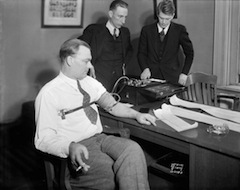 You’ve seen them on TV crime dramas. A potential suspect is wired to a machine via a series of sensors attached to his body while he is grilled by an expert operator with a series of probing questions. Eventually, a needle goes haywire, and the lie is revealed. Well, not so fast. There are some serious misconceptions about the lie detector test, and we’re going to discuss ten of them below:
- The Name Itself– The first misconception to address is the very name lie detector test. It is more correctly known as a polygraph, and can be more accurately considered to be a truth verifier test, because …
- They Don’t Detect Lies – Polygraphs can confirm that a person is responding truthfully to a question; however, the body functions that are monitored in a polygraph test will not specifically identify a lie, simply an abnormal physiological reaction.
- They Are 100% Accurate – When administered by an experienced professional examiner, a polygraph test can be very accurate in establishing truth or indicating deception, but there are many factors that can alter their reliability.
- They Are Not Admissible In Court – Contrary to the belief even among some lawyers, this is no longer universally true. There have been cases where polygraph results have been entered as evidence in trials.
- You Can “Beat” A Polygraph Test – A professional examiner will conduct a polygraph in three phases – the pre-exam interview, the polygraph exam, and the post-exam interview – over the course of several hours. The exam will include control questions, which are designed to confirm the truthfulness of the responses.
- Drugs Can Help You Beat The Exam – Drugs or medications won’t aid in defeating a polygraph. Part of the pre-exam phase is for the examiner to ensure that the subject is fit to take the exam, and verify if any medications have been taken.
- Nerves Can Affect The Results Of A Test – Nervousness does not register in the same way the physiological response of the nervous system does during a polygraph. Also, the examiner will work with the subject throughout the process to ensure that they are as relaxed as possible.
- Polygraphs Include Trick Questions Intended to Elicit A Response – In fact, the respondent will be made aware in advance, of every question he will be asked in the polygraph exam. There are no surprise questions.
- Control Questions Are Standard Questions With Standard Responses – Not exactly. A control question is not something like “Is your last name Lipschitz”. The purpose of a control question is to induce the subject into giving a deceptive answer, so that the examiner can have reliable measurements of what a deceptive response will look like.
- You Only Fail If You Lie – While polygraphs do have a high percentage of accuracy when administered by a well-trained and qualified examiner, it’s quite possible to be completely truthful and still “fail” a polygraph exam.
Interviewing Tips
May 4, 2012INTERVIEWING TIPS
the applicant’s body language during the interview. Since interviewing is a skill that is learned and revised over the years, most families do not have the time,
training or luxury that some HR personnel have. In fact, most family members report limited experience with the process. Below are some basic tips for the interviewer
Continue reading →
Links & News Sources
May 4, 2012LINKS/REFERENCES/CITES:
http://www.brbpublications.com/default.aspx
http://www.lexisnexis.com/news/
http://www.facebook.com/srch.php?ref=ffs
http://www.corrections.com/links/show/30
https://www.vinelink.com/vinelink/initMap.do
http://www.transunion.com/corporate/business/business.page
http://www.uscis.gov/portal/site/uscis
http://www.ftc.gov/os/statutes/fcrajump.shtm
http://www2.ed.gov/admins/finaid/accred/index.html
Run A Background Check Now
Fast, reliable & secure background checks are just a few clicks away.
Choose a plan & click to start your check at eNannySource.com

Recent Articles
- How to Reject a Nanny Applicant Gracefully
- How to Monitor The Quality of Care Your Children Receive
- How to Check Up on Your Nanny When You Don’t Have Nanny Cams
- 10 Unwritten Playground Rules All Parents Should Follow
- 12 Tips for Keeping the Backyard Safe This Spring
- 10 Things Moms do That Could Get Them in Trouble with the Law
- How to Snoop on Your Kid While He’s Online
- 10 Reasons Parents Should Not Have Guns in the House
- 10 of the Most Important Things to Include in Your Nanny Contract
- 10 Signs a Nanny Candidate Might Be the Wrong Choice
Article Archives
- September 2013
- August 2013
- June 2013
- April 2013
- March 2013
- February 2013
- January 2013
- December 2012
- November 2012
- October 2012
- September 2012
- August 2012
- July 2012
- June 2012
- May 2012
- April 2012
- March 2012
- February 2012
- January 2012
- December 2011
- November 2011
- October 2011
- September 2011
- August 2011
- May 2011